Wherever I go on the Internet, it seems every site is eager to inform me that they use cookies. The info comes as a (often) large banner with an Ok-button. If I click the Ok-button, the banner goes away and I get a lot more space on the screen. The next time I visit the site, it remembers it has shown me the cookie info. I can thank a cookie for that, the cookie that the site created on my device with the help of the browser.
A cookie is a text-file. That means it cannot be executed. It can only be created, read and modified by a site and that's all done by the browser on the site's request. A site can only interact with (create, read or modify) its own cookies. So cookies are quite innocent then and won't breach my privacy?
No, they are not innocent! There is a company called DoubleClick (a subsidiary of Google), and probably some others, that use cookies in a way that fundamentally changes their nature. It makes certain cookies global. Through mediation of DoubleClick a cookie can turn up on any site that allows it to.
Here's an example. I have a Facebook account and I usually don't click on advertizements. However a few weeks ago I did click on an advertizement in Facebook that I hadn't seen before. The click took me to the site of a well-established online-shop. Nothing sinister about that. However, since that click I've been seeing that same advertizement on Facebook, but also on some other favorite sites. That could only have happened by means of a global cookie. I don't quite like that, because it means someone can follow my web-surfing habits.
But what if you, as user, don't accept cookies at all? Sorry, doesn't work. A lot of sites wouldn't function without them and consequently you couldn't use them, so you need cookies. Removing them after every browsing session is a hassle, but it should help. Removing cookies when you switch from one site to another would probably make it difficult to follow you. However removing all cookies means you would have to give up convenience. E.g. you would become an unknown user for every site and would have to enter your login credentials at every visit to the sites where you have a login and need to login.
There's no viable or user friendly cure other than changed rules. Global cookies would have to be outlawed or somehow made impossible.
Proctele apps in the App Store

Click the picture to see Proctele apps in Apple's App Store
Tuesday, December 2, 2014


Tuesday, November 25, 2014
NumberWiz Solution: 265 with large numbers
In the last blogpost I challenged all you number-heads with this sum:
Add, subtract, multiply or divide the following six numbers 2 7 25 50 75 100 to get 265.
You notice that it contains all the big numbers and two small.
In an update I hinted that 5 was a key number in the solution.
It's also worth noting that 265 = 250 + 15.
Now watch the solution:
265 = (50 x 25 + 75) / (7 - 2) = ((50 x 25) / 5) + (75 / 5) = 250 + 15
Add, subtract, multiply or divide the following six numbers 2 7 25 50 75 100 to get 265.
You notice that it contains all the big numbers and two small.
In an update I hinted that 5 was a key number in the solution.
It's also worth noting that 265 = 250 + 15.
Now watch the solution:
265 = (50 x 25 + 75) / (7 - 2) = ((50 x 25) / 5) + (75 / 5) = 250 + 15
Sunday, November 23, 2014
NumberWiz Sum: 265 with large numbers
Time for another NumberWiz sum. I might make an update with a tip later, because not a lot of people will find it easy.
Add, subtract, multiply or divide the following six numbers 2 7 25 50 75 100 to get 265.
Send an email or answer in a comment if you like.
Update: A key number in this sum is 5.
Add, subtract, multiply or divide the following six numbers 2 7 25 50 75 100 to get 265.
Send an email or answer in a comment if you like.
Update: A key number in this sum is 5.
Tuesday, November 11, 2014
NumberWiz Sum 474: Solution
The problem was:
Add, subtract, multiply or divide the following six numbers 2 4 6 9 75 100 to get 474.
In an update I hinted that 474 is divisible by 6, hence a solution is:
474 = 6 x 79 = 6 x (75 + 4)
Another solution: 474 = 4 x 100 + (75 + 2 + 6 - 9)
Add, subtract, multiply or divide the following six numbers 2 4 6 9 75 100 to get 474.
In an update I hinted that 474 is divisible by 6, hence a solution is:
474 = 6 x 79 = 6 x (75 + 4)
Another solution: 474 = 4 x 100 + (75 + 2 + 6 - 9)
Saturday, November 8, 2014
NumberWiz Sum 474
Here's a nice sum:
Add, subtract, multiply or divide the following six numbers 2 4 6 9 75 100 to get 474.
Send an email or answer in a comment if you like.
Update:
474 is divisible by 2, of course, and what's more, 474 / 2 = 237 is divisible by 3.
That's a good help.
Add, subtract, multiply or divide the following six numbers 2 4 6 9 75 100 to get 474.
Send an email or answer in a comment if you like.
Update:
474 is divisible by 2, of course, and what's more, 474 / 2 = 237 is divisible by 3.
That's a good help.
Wednesday, October 29, 2014
Apple Device's Positioning
We all know that GPS is a positioning system based on satellites and that it's American. But not everyone knows about GLONASS. It's a Russian satellite based positioning system. From iPhone 4S onwards, all Apple's mobile devices with GPS, also have GLONASS. The devices use both in parallel; they're on the same micro-chip. Having two systems gives better positioning than having one. Being Russian GLONASS works best in Russia, but since 2011 it's truly global, like GPS.
Another positioning method is iBeacon, which works over short distances. It can help smartphones determine their precise position or context. It uses low-power Bluetooth 4.0 and reaches anywhere between a few centimeters and 450 m / 1500 ft. All Apple Stores in the US have iBeacon devices.

Another positioning method is iBeacon, which works over short distances. It can help smartphones determine their precise position or context. It uses low-power Bluetooth 4.0 and reaches anywhere between a few centimeters and 450 m / 1500 ft. All Apple Stores in the US have iBeacon devices.
Then there's WiFi, which we all think of simply as wireless Internet, and that's what it is. However WiFi routers have the potential to be used for positioning, if someone like Google cares to build a database of WiFi routers. Google has done that using its mapping cars who have passed many many routers on their endless journeys and taken notes.
Finally there's the compass, which all iOS products now contain. It's actually a very small magnetometer and it's coupled with an accelerometer. That coupling enables the device to know what direction it's pointing. Proctele's app TCompanion makes use of that to help map-challenged people like myself to find our way.
The inspiration for this blog entry is the wonderful device in the picture - iPad Air 2 - and the WiFi + 3G version has all the above positioning technologies:
Saturday, October 25, 2014
New and Classic
A new product category nearly always starts off with something that looks rather clunky. At least that's how we see it when we look back. Examples are radios, mobile music players and TVs.




I remember seeing radio receivers similar to these when I was younger. The one on the right is very similar to a radio my parents had. The one on the left resembles a radio my grandparents had. It had a mighty sound and took some time to warm up before there was any sound coming out of it.
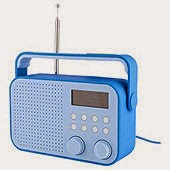
A radio nowadays looks either similar or very different from those above. There seems to be a keen interest in old-style radios as well as new shapes like this one:
Then there are products that aren't radios, but speakers that you connect your iPhone to via Bluetooth or Wi-Fi. Here's a comfy one with built-in sub-woofer:
But what's a radio compared to a Smartphone. It's just one of a Smartphone's functions. Smartphone is what you use now to listen to music. They do have a problem though that doesn't seem to be going away. Gadget makers know that and are happy to oblige. A power pack or two, or three, is what we need:
Those are available in many shapes and colors. The red one is an Ironman suitcase power pack. Things aren't like they used to and when it comes to gadgets, I think 2014 easily beats, say 1964. Anyway there is a lot more to choose from nowadays.
Subscribe to:
Posts (Atom)